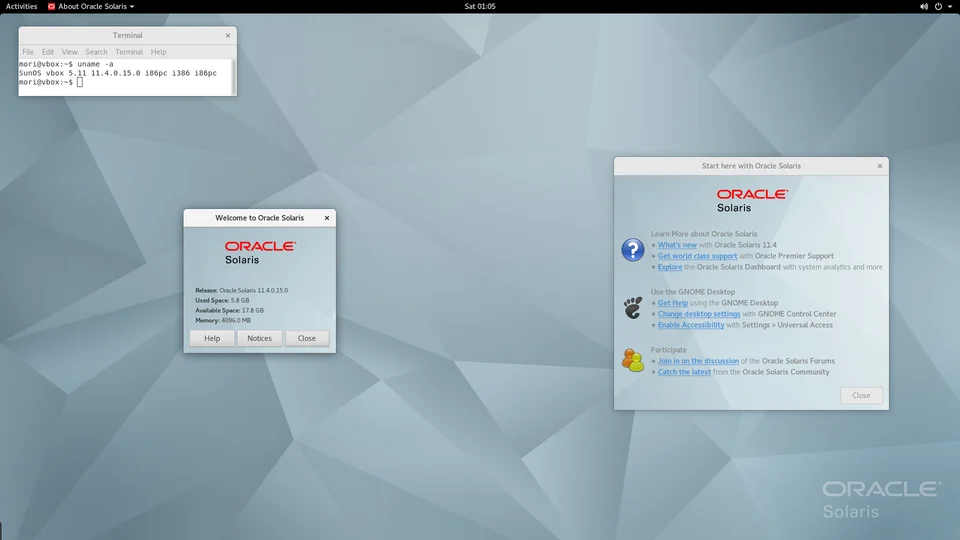
Solaris is a proprietary Unix-based operating system originally developed by Sun Microsystems. Over the decades, it has been a cornerstone of enterprise computing, powering large-scale databases, financial systems, and web infrastructures.
Here is a breakdown of what makes Solaris significant, its history, and its current status.
1. Origins and History
- Birth: Solaris was born in the early 1990s as the successor to SunOS. It was built to run on Sun’s SPARC architecture, though it later added support for x86 processors.
- The Golden Age: During the dot-com boom of the late 90s and early 2000s, Solaris was the go-to OS for massive “dot-com” server deployments.
- Oracle Acquisition: In 2010, Oracle Corporation acquired Sun Microsystems. This acquisition shifted the focus of Solaris primarily toward supporting Oracle’s own hardware (SPARC) and database software (Oracle Database).
2. Key Technical Innovations
Solaris is famous for introducing features that were years ahead of their time, many of which have since been adopted by Linux and other systems:
- ZFS (Zettabyte File System): Perhaps the most famous feature of Solaris. It is a revolutionary file system that combines volume management and file management, providing built-in data integrity checks, snapshots, and protection against data corruption.
- DTrace: A powerful dynamic tracing framework that allows administrators and developers to inspect the kernel and user processes in real-time without needing to restart the system or pause execution.
- Solaris Zones (Containers): One of the earliest implementations of OS-level virtualization. It allows a single instance of Solaris to be partitioned into multiple isolated “zones,” each acting like a separate server but sharing the same kernel.
- Fault Management Architecture (FMA): A sophisticated system that can predict hardware failures before they happen and proactively retire components or move workloads to prevent crashes.
3. Open Source Legacy: OpenSolaris
In 2005, Sun Microsystems open-sourced the Solaris codebase under the CDDL (Common Development and Distribution License), calling it OpenSolaris.
When Oracle acquired Sun in 2010, they effectively killed the OpenSolaris project. This led to a community fork called illumos, which serves as the base for several modern open-source Unix-like operating systems today, such as OpenIndiana and SmartOS.
4. Why Solaris Declined
- The Rise of Linux: In the 2000s, Linux became faster, cheaper, and better supported by hardware vendors. Companies began moving away from expensive proprietary Unix systems toward commodity x86 hardware running Linux.
- Strategic Missteps: After the Oracle acquisition, many long-time Sun engineers left, and the community felt alienated by Oracle’s restrictive licensing and shift away from open-source transparency.
- Proprietary Nature: Unlike Linux, Solaris is not “free” in the traditional sense, making it difficult for startups and individual developers to adopt compared to Ubuntu, CentOS, or Debian.
5. Solaris Today
Solaris is currently in a state of maintenance mode.
- Oracle Solaris 11 is the final major release.
- Oracle has committed to supporting Solaris 11 through 2034 under its “Extended Support” program.
- It is still used by large legacy enterprises (banks, telecommunications, and government agencies) that have mission-critical applications running on SPARC hardware that would be too costly or risky to port to Linux.
Summary: Why it matters
Even if you never use Solaris, you are likely using technology that originated there. If you use Docker (based on containers), ZFS (now standard on many enterprise storage systems), or DTrace (now ported to Linux and macOS), you are benefiting from the innovations engineered by the Solaris team.
If you want to try an OS that feels like Solaris today, the best options are OpenIndiana (desktop-focused) or SmartOS (cloud/server-focused), both of which are based on the open-source illumos kernel.