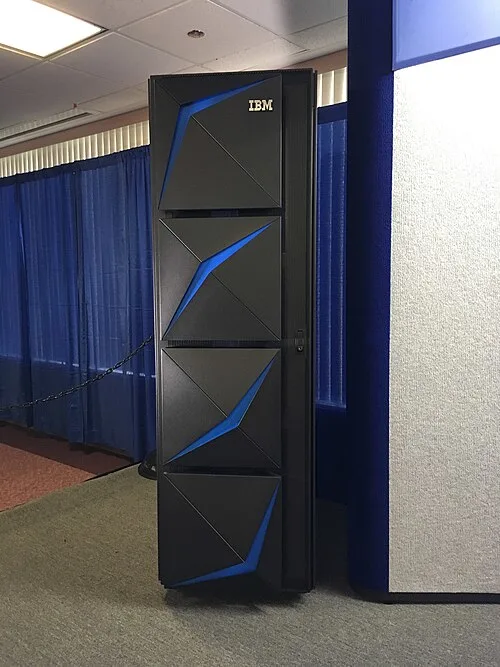
Mainframes are high-performance, ultra-reliable computers used by large organizations for critical applications, bulk data processing, and enterprise-level transaction processing.
While the general public uses PCs and smartphones, the global economy—banking, insurance, retail, and government—runs on mainframes.
Here is a breakdown of what you need to know about mainframes:
1. Key Characteristics
- Reliability and Availability: Mainframes are designed for “five nines” of availability (99.999% uptime). They are built with redundant hardware so that if a component fails, the system continues to operate without interruption.
- Scalability: They can handle massive amounts of input/output (I/O) operations. A single mainframe can manage petabytes of data and process millions of transactions per second.
- Security: Security is baked into the hardware and the operating system. They are virtually immune to common viruses that affect Windows or Linux PCs and are the gold standard for data encryption.
- Backward Compatibility: Programs written for mainframes 30 or 40 years ago can often still run on the latest models today.
2. What are they used for?
Mainframes are not designed for web browsing or gaming; they are “workhorses.” Common use cases include:
- Banking & Finance: Processing credit card transactions, ATM withdrawals, and stock trades.
- Insurance: Calculating premiums and processing millions of claims.
- Government: Managing census data, social security records, and tax filings.
- Retail: Managing massive supply chains and inventory databases for global retailers (e.g., Walmart).
- Airlines: Handling reservation and ticketing systems (like the Sabre system).
3. The “Mainframe Ecosystem”
- IBM: IBM is the dominant player in the mainframe market (the IBM Z series). For many, “Mainframe” and “IBM Z” are synonymous. Other companies like Unisys also produce mainframe-class systems.
- Operating Systems: They don’t run Windows or macOS. They typically run specialized OSs like z/OS, z/VM, or Linux on Z.
- Languages: While modern mainframes support Java, Python, and C++, the “native” language of the mainframe is COBOL. A significant portion of the world’s business logic is still written in COBOL.
- Databases: The most common database used on mainframes is DB2, known for its ability to handle immense relational data loads.
4. Why haven’t they been replaced by the Cloud?
Many people predicted the “death of the mainframe” when PCs and servers arrived in the 80s and 90s. Yet, they remain. Here is why:
- Cost-per-transaction: When you are processing billions of transactions a day, it is actually cheaper to do it on a single mainframe than to coordinate thousands of smaller servers.
- Data Gravity: The data is already there. Moving petabytes of mission-critical data to the cloud is risky, expensive, and logistically nightmarish.
- Hybrid Cloud: Modern mainframes are not “old-school.” IBM now integrates mainframes directly into hybrid cloud environments, allowing developers to build mobile apps that “talk” to mainframe data via APIs.
5. Common Myths
- Myth: “Mainframes are dead.”
- Fact: Approximately 70–80% of the world’s corporate data resides on or originates from mainframes.
- Myth: “Mainframes are just giant PCs.”
- Fact: They are architecturally different. They use specialized processors (like the z16 CPU) and have a massive focus on I/O bandwidth that consumer hardware cannot match.
- Myth: “Only old people work on mainframes.”
- Fact: There is a growing demand for younger engineers to manage “Mainframe Modernization” projects, which involve bridging the gap between legacy systems and modern cloud architecture.
Summary
If a PC is a sports car meant for one driver and high speed, a mainframe is a freight train. It might not be “flashy,” but it carries the heavy load of the entire global economy, moving massive amounts of cargo reliably, safely, and constantly.