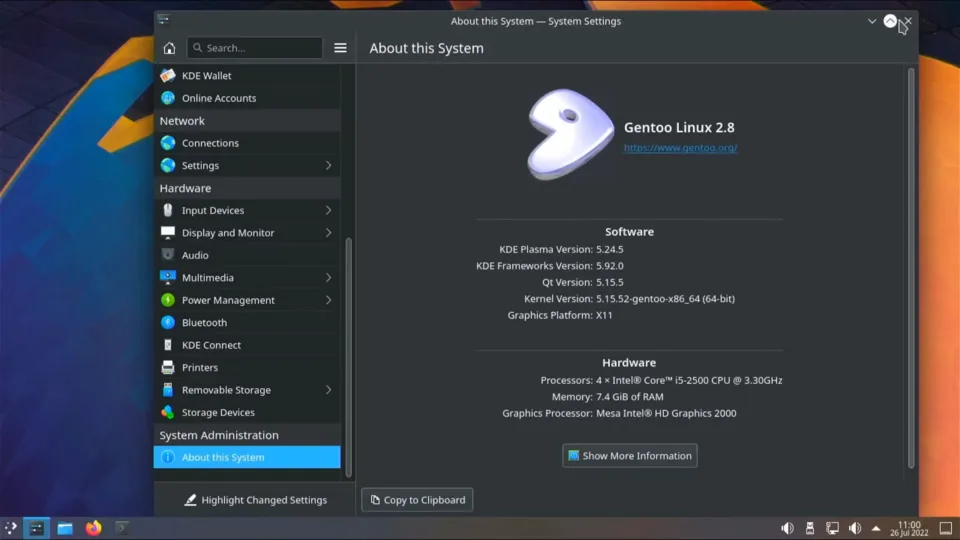
Gentoo Linux is one of the most unique and technically demanding distributions in the Linux ecosystem. Unlike mainstream distributions like Ubuntu or Fedora, which provide pre-compiled software, Gentoo is a source-based distribution.
Here is a breakdown of what makes Gentoo special, how it works, and who it is for.
1. The Core Philosophy: “The Meta-Distribution”
Gentoo is often called a “meta-distribution” because it is designed to be highly modular and customizable. Instead of installing pre-built binaries (like .deb or .rpm files), the user downloads the source code and compiles it locally on their machine.
2. Key Features
A. Portage (The Package Manager)
Portage is Gentoo’s heart. It is one of the most advanced package management systems in the Unix world.
- USE Flags: This is Gentoo’s “killer feature.” A user can define “USE” flags globally or per-package to dictate which features a program should be compiled with. For example, if you don’t need Bluetooth support in your media player, you can disable the
bluetoothflag, and the software will compile without that bloat. - Slots: Portage allows multiple versions of the same package to coexist on the system simultaneously (e.g., having both Qt4 and Qt5 installed for different applications).
B. Optimization
Because you compile everything from source, you can optimize the software specifically for your CPU architecture (using CFLAGS). While the real-world performance gains are often debated, it allows users to strip out unnecessary dependencies and keep their system extremely lean and customized to their exact hardware.
C. Rolling Release
Gentoo is a rolling-release distribution. You install it once, and then you keep it updated forever. There are no “Version 22.04” or “Version 23” upgrades; you simply sync your local repository with the Gentoo servers and update as new versions of software become available.
3. The “Gentoo Experience”
- Compilation Time: Compiling large software suites (like LibreOffice, Firefox, or the KDE Plasma desktop) can take hours, or even days on older hardware. This is the “tax” you pay for the control you get.
- The Handbook: Gentoo is famous for its Gentoo Handbook. It is considered one of the best pieces of documentation in the Linux world. It walks you through every step of a manual installation, from partitioning the disk to configuring the Linux kernel.
- The Learning Curve: Installing Gentoo is a rite of passage for many Linux enthusiasts. You learn how the kernel interacts with hardware, how shared libraries work, and how the entire boot process functions.
4. Who is Gentoo for?
- Learners: If you want to deeply understand how Linux works under the hood, there is no better teacher than Gentoo.
- Performance Enthusiasts: People who want a system that contains only what they need and nothing else.
- Embedded Developers/Sysadmins: The level of granular control is perfect for specialized hardware or servers that require specific configurations.
- “Tinkerers”: If you enjoy the process of configuring and optimizing your machine as much as you enjoy using it, Gentoo is the ultimate playground.
5. Why might you avoid Gentoo?
- Time Commitment: You must be prepared to manage updates, resolve occasional dependency conflicts, and wait for software to compile.
- Complexity: It is not a “plug-and-play” experience. If you just want a computer that works immediately to browse the web or play games, mainstream distributions are much more practical.
- Hardware Bottleneck: If you have a very slow computer, the compilation times will become a significant hindrance to your productivity.
Summary
Gentoo is not just an operating system; it is a learning platform. It gives you total ownership of your software. If you’ve reached a point where you feel limited by the choices made by the maintainers of distributions like Debian or Arch, and you want to decide exactly how every piece of software on your computer is built, Gentoo is the destination.