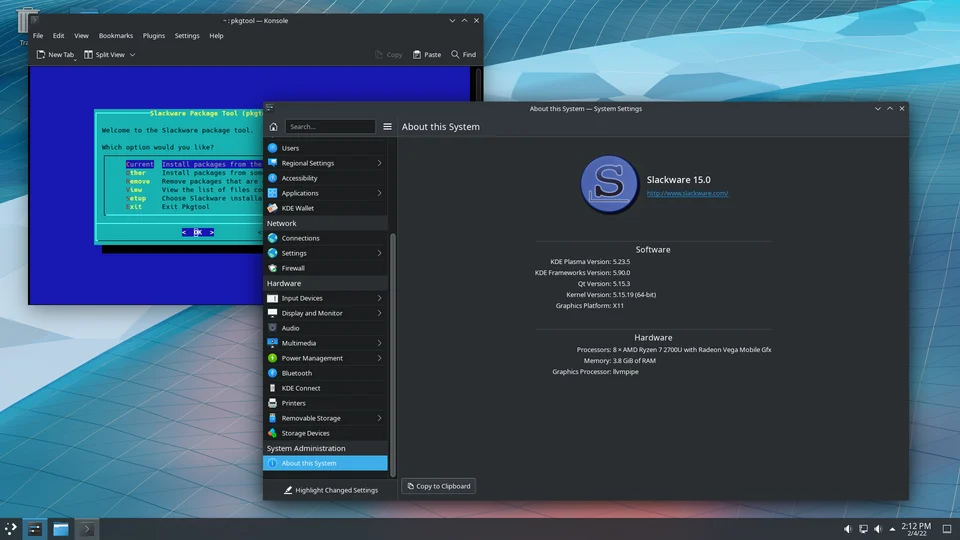
Slackware Linux holds a unique and legendary place in the history of computing. Created by Patrick Volkerding in 1993, it is the oldest surviving Linux distribution that is still actively maintained.
Here is a breakdown of what makes Slackware stand out in the Linux ecosystem.
1. The Core Philosophy: “Keep It Simple”
Slackware’s design philosophy is rooted in the KISS (Keep It Simple, Stupid) principle. It adheres closely to the original UNIX design.
- No “Magic”: Unlike modern distributions (like Ubuntu or Fedora) that use complex automation or heavy abstractions, Slackware expects the user to know how their system works.
- Script-based: System configuration is done through plain-text files and shell scripts. If you want to change a system setting, you open a text editor and edit a configuration file.
- The “Slack” Way: There is no overarching “Control Panel.” The system is modular and transparent.
2. BSD-Style Init System
While most modern Linux distributions have migrated to systemd, Slackware maintains the traditional System V-style init system.
- System services are started via simple shell scripts located in
/etc/rc.d/. - For many long-time Linux users and Unix purists, this is considered cleaner, easier to debug, and more predictable than the complex binary-based
systemdecosystem.
3. Package Management: The Manual Approach
Slackware uses pkgtool and a simple tarball-based package format (.txz).
- No Automatic Dependency Resolution: This is the most infamous aspect of Slackware. When you install a package, the system generally does not automatically go out and fetch the required libraries (dependencies) for you. It assumes you are capable of managing your own software stack.
- Slackbuilds: To help manage this, the community uses SlackBuilds.org, a repository of scripts that help users compile software from source in a clean, Slackware-native way.
- Slackpkg: While Slackware is manual, it does include
slackpkg, a tool for keeping the core distribution updated.
4. Stability and Conservatism
Slackware is notoriously conservative.
- It does not chase the “bleeding edge.” You won’t find the newest kernel or the latest experimental software included by default until the developers are absolutely certain it is stable.
- “If it isn’t broken, don’t fix it” is the unofficial motto. This makes Slackware incredibly reliable for servers or workstations that need to remain unchanged for long periods.
5. Who is Slackware for?
Slackware is not typically recommended for absolute beginners, but it is the best distribution for learning how Linux actually works.
- The Learner: If you want to understand the relationship between the kernel, the init system, and user-space applications, Slackware is the best “classroom.”
- The Purist: If you dislike the complexity and bloat of modern Linux distributions and want a system that stays out of your way, Slackware is the gold standard.
- The Administrator: Because it is so stable and predictable, it is a favorite for those who want to build a custom, minimalist server environment.
6. The Future
Despite the rise of containers, cloud-native OSs, and systemd, Slackware continues to thrive under the guidance of Patrick Volkerding. It retains a very dedicated, highly skilled community. It is a “craftsman’s OS”—it requires more effort to set up than a modern desktop OS, but it rewards the user with a system that is entirely under their control.
Where to start?
If you are interested in trying it, visit the official website. Be prepared to read the documentation—Slackware is a distribution that rewards those who take the time to read the README files!