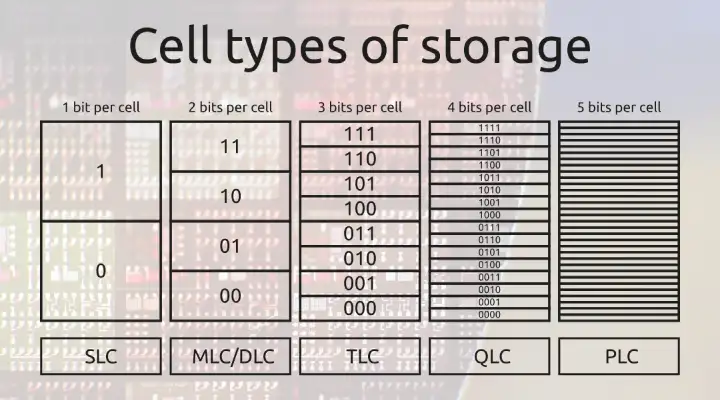
In flash memory, the “data level” refers to the number of bits stored per memory cell. As technology has evolved, manufacturers have developed ways to store more information in the same physical space by increasing the precision of the voltage levels within each cell.
Here is a comparison of the primary data levels in flash memory:
1. SLC (Single-Level Cell)
- Bits per Cell: 1
- States: 2 (0 or 1)
- How it works: The cell is either “on” or “off.” It measures a simple threshold voltage to determine the bit.
- Pros: Highest reliability, fastest read/write speeds, and longest lifespan (highest P/E cycles—Program/Erase cycles).
- Cons: Most expensive per gigabyte; lowest storage density.
- Use Case: Enterprise servers, mission-critical industrial applications.
2. MLC (Multi-Level Cell)
- Bits per Cell: 2
- States: 4 (00, 01, 10, 11)
- How it works: The controller manages four distinct voltage levels within the cell.
- Pros: Better density than SLC; lower cost per GB.
- Cons: Slower than SLC; lower endurance; more prone to read errors due to tighter voltage margins.
- Use Case: High-end consumer SSDs, workstation drives.
3. TLC (Triple-Level Cell)
- Bits per Cell: 3
- States: 8 (000 through 111)
- How it works: Requires eight distinct voltage levels. This requires very high precision, as the margins between “states” are very narrow.
- Pros: High density; very affordable; standard for most modern consumer SSDs.
- Cons: Lower endurance and slower write speeds compared to MLC/SLC.
- Use Case: General consumer computing, laptops, gaming consoles.
4. QLC (Quad-Level Cell)
- Bits per Cell: 4
- States: 16
- How it works: Manages 16 distinct voltage levels. This is technically difficult to maintain because the voltage “windows” are tiny, making the cell sensitive to electrical noise and data degradation.
- Pros: Extremely high storage capacity; lowest cost per GB.
- Cons: Significantly lower endurance (fewer P/E cycles); slower write speeds (often utilizes a cache to mitigate this).
- Use Case: Read-intensive workloads, massive data storage, budget-friendly SSDs.
5. PLC (Penta-Level Cell)
- Bits per Cell: 5
- States: 32
- How it works: Storing 32 voltage levels is at the bleeding edge of current physics. It requires extremely sophisticated error correction (ECC) to distinguish between the 32 states.
- Pros: Massive capacity potential.
- Cons: Very limited endurance; high latency; currently not widely adopted.
- Use Case: Experimental/Future long-term cold storage.
Summary Comparison Table
| Type | Bits/Cell | Voltage States | Endurance (P/E Cycles) | Speed | Cost |
|---|---|---|---|---|---|
| SLC | 1 | 2 | ~100,000 | Highest | Highest |
| MLC | 2 | 4 | ~3,000 – 10,000 | High | High |
| TLC | 3 | 8 | ~1,000 – 3,000 | Moderate | Low |
| QLC | 4 | 16 | ~100 – 1,000 | Low | Lowest |
Key Takeaways
- The Density-Endurance Trade-off: As you increase the bits per cell, you increase the capacity and lower the cost, but you inevitably decrease the endurance and speed.
- Voltage Precision: The core challenge of increasing data levels is noise. Because the voltage levels are so close together in TLC and QLC, small amounts of electrical interference or “cell wear” can cause the controller to misread the data. This is why high-level cells rely heavily on complex Error Correction Code (ECC) algorithms.
- Modern Mitigation: Modern drives use SLC Caching—a process where a portion of the TLC/QLC flash is treated as SLC memory to speed up write operations before moving the data to the slower, higher-density cells later.