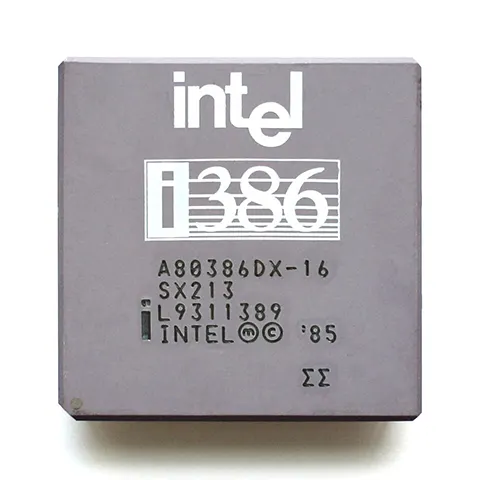
The Intel 80386 (often shortened to i386) was a 32-bit microprocessor released in 1985. It was a huge leap forward from its predecessors, the 8086 and 80286, and fundamentally changed the landscape of personal computing. Here’s a detailed look at its history, architecture, features, and impact:
1. Historical Context & Development
- Following the 80286: The 80286 introduced protected mode, but it had limitations. Switching between real mode (for compatibility with older software) and protected mode was slow and cumbersome.
- Need for 32-bit Power: Software was starting to demand more processing power and memory than the 16-bit architecture of the 8086/80286 could efficiently provide.
- Release Date: November 9, 1985.
- Clock Speeds: Initially released at 16 MHz, later versions reached 20, 25, 33, and even 40 MHz.
- Manufacturing Process: Initially manufactured using a 1.5 μm process, later refined to 1.0 μm and 0.8 μm.
2. Key Architectural Features
- 32-bit Architecture: This was the biggest change. The 80386 could process 32 bits of data at a time, significantly increasing performance. This meant:
- Larger Addressable Memory: Could address up to 4 GB of RAM (compared to the 1 MB limit of the 80286).
- Wider Registers: 32-bit general-purpose registers (EAX, EBX, ECX, EDX, ESI, EDI, EBP, ESP) for faster calculations and data manipulation.
- 32-bit Internal Data Bus: Faster data transfer within the CPU.
- Instruction Set:
- Backward Compatibility: Fully compatible with the 8086/80286 instruction sets, allowing existing software to run.
- New Instructions: Added new 32-bit instructions to take advantage of the new architecture.
- Memory Management:
- Protected Mode Improvements: Significantly improved protected mode, making it much more practical and efficient. Allowed for multitasking, memory protection, and virtual memory.
- Virtual 8086 Mode: Allowed running 8086 programs within a protected mode environment, providing a degree of isolation and security.
- Pipelining: The 80386 employed a 6-stage instruction pipeline, allowing multiple instructions to be processed concurrently, boosting performance. (Fetch, Decode, Execute, Address, Fetch Operand, Write Back)
- On-Chip Memory Management Unit (MMU): Integrated the MMU onto the chip itself, simplifying system design and improving performance.
- Floating-Point Unit (FPU): The original 80386 did not include an integrated FPU. The 80387 math coprocessor was a separate chip that plugged into a dedicated socket on the motherboard. Later versions (80486) integrated the FPU.
3. Operating Modes
- Real Mode: Emulates the 8086/80286 environment. Used for compatibility with older software and during the boot process. Limited to 1MB of RAM.
- Protected Mode: The primary mode for modern operating systems. Provides memory protection, multitasking, and access to the full 4GB of RAM.
- Virtual 8086 Mode: Allows running 8086 programs within a protected mode environment.
4. Impact and Significance
- Birth of 32-bit Computing: The 80386 is widely considered the processor that truly brought 32-bit computing to the mainstream.
- Windows 3.0 & Beyond: Windows 3.0 (released in 1990) was designed to take full advantage of the 80386’s protected mode, leading to a significant improvement in performance and usability. This was a turning point for Windows.
- Rise of DOS Extenders: DOS extenders (like QEMM) allowed DOS programs to access more than 640KB of memory by utilizing the 80386’s protected mode.
- Linux’s Early Adoption: Linux, initially developed by Linus Torvalds, was one of the first operating systems to be designed specifically for the 80386’s 32-bit architecture.
- Foundation for Future Processors: The 80386 laid the groundwork for the subsequent Intel processors (80486, Pentium, etc.). Many of the architectural concepts introduced in the 80386 were carried forward.
5. Technical Specifications (Typical 80386DX)
- Word Size: 32-bit
- Number of Transistors: 275,000
- Clock Speed: 16-40 MHz
- Bus Width: 32-bit
- Addressable Memory: 4 GB
- Cache: None on-chip (early versions relied on external cache)
- Socket Type: Pin Grid Array (PGA)
- Power Consumption: Varies depending on clock speed and voltage.
6. Variants
- 80386DX: The full 32-bit version with an integrated memory management unit. The most common and powerful version.
- 80386SX: A reduced version with a 16-bit external data bus. It was cheaper to manufacture and used in lower-end systems. It still had a 32-bit internal architecture but was limited by the narrower bus.
- 80386SL: An energy-efficient version of the 80386SX, designed for portable computers.
Where to find more information
- Wikipedia: https://en.wikipedia.org/wiki/Intel_80386
- CPU-World: https://www.cpu-world.com/CPUs/80386/index.html
- YouTube (Retro Tech Videos): Search for “Intel 80386” on YouTube for many informative videos.
In conclusion, the Intel 80386 was a pivotal processor that ushered in the era of 32-bit computing, paving the way for the modern PCs we use today. Its architectural innovations and improved performance were instrumental in the development of more powerful operating systems and applications. It remains a significant milestone in the history of computing.