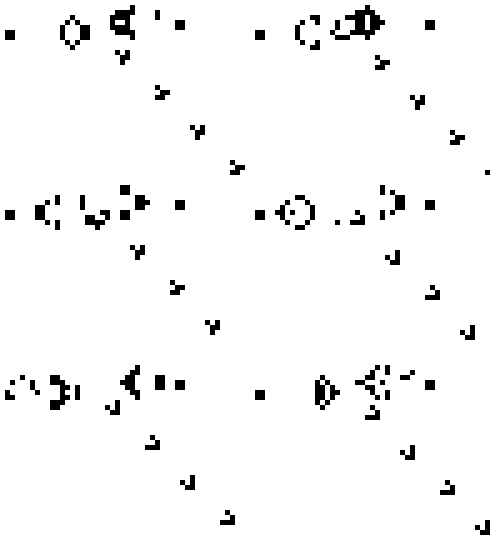
Conway’s Game of Life is a fascinating example of a cellular automaton, invented by British mathematician John Horton Conway in 1970. Despite its simple rules, it exhibits complex and emergent behavior, making it a popular subject in mathematics, computer science, and even philosophy. Here’s a comprehensive overview:
1. The Basics: Rules and Setup
- The Grid: The Game of Life takes place on an infinite, two-dimensional orthogonal grid of square cells. In practice, implementations use finite grids with wrapping edges (toroidal topology) or fixed boundaries.
- Cell States: Each cell in the grid can be in one of two states:
- Alive (or On): Represented visually as a filled cell.
- Dead (or Off): Represented visually as an empty cell.
- Generations: The game progresses in discrete time steps called generations. The state of each cell in the next generation is determined by its current state and the states of its eight neighbors (the Moore neighborhood).
- The Rules (applied simultaneously to all cells):
- Any live cell with fewer than two live neighbours dies (underpopulation).
- Any live cell with two or three live neighbours lives on to the next generation.
- Any live cell with more than three live neighbours dies (overpopulation).
- Any dead cell with exactly three live neighbours becomes a live cell (reproduction).
That’s it! These four simple rules govern the entire system.
2. Key Concepts & Terminology
- Neighborhood: The eight cells surrounding a given cell.
- Moore Neighborhood: The standard neighborhood used in the Game of Life, consisting of the eight adjacent cells.
- Von Neumann Neighborhood: An alternative neighborhood consisting of the four cardinal direction neighbors (north, south, east, west). Less commonly used in standard Game of Life.
- Still Life: A configuration of cells that remains unchanged from one generation to the next. Examples include the Block, Beehive, and Loaf.
- Oscillator: A configuration that returns to its original state after a finite number of generations. The most famous is the Blinker, which oscillates between horizontal and vertical configurations.
- Spaceship: A configuration that translates itself across the grid over time. The most famous is the Glider, which moves diagonally.
- Gun: A configuration that emits spaceships (like Gliders) periodically. The most famous is the Gosper Glider Gun.
- Methuselah: A configuration with a very long lifespan before stabilizing or dying.
- Garden of Eden: A pattern with no still lifes, oscillators, or spaceships, but which remains alive indefinitely.
- Emergent Behavior: Complex patterns and behaviors that arise from the simple rules, not explicitly programmed into the system. This is a key characteristic of the Game of Life.
- Universal Constructor: A theoretical pattern capable of replicating itself. Conway proved that such a constructor is possible, but finding a practical one is extremely difficult.
3. Why is it Important?
- Complexity from Simplicity: The Game of Life demonstrates how complex behavior can emerge from very simple rules. This is a fundamental concept in complex systems theory.
- Computational Universality: The Game of Life is Turing complete, meaning it can theoretically compute anything that a computer can compute. This was proven by Conway himself. While impractical, it demonstrates the power of the system.
- Modeling Natural Phenomena: The Game of Life has been used as a model for various natural phenomena, such as:
- Population Dynamics: The rules can be seen as representing birth, death, and competition for resources.
- Crystal Growth: Patterns can resemble the growth of crystals.
- Chemical Reactions: The spread of patterns can be analogous to the propagation of chemical reactions.
- Artificial Life: It’s a foundational example in the field of artificial life, exploring the principles of self-organization and evolution.
- Educational Tool: It’s a great way to teach concepts like algorithms, cellular automata, and emergent behavior.
4. Common Patterns & Configurations
Here are a few well-known patterns:
- Block: A 2×2 square of live cells. A simple still life.
- Beehive: A hexagon-shaped still life.
- Loaf: A more complex still life.
- Blinker: An oscillator that alternates between a horizontal and vertical line of three cells.
- Glider: A spaceship that moves diagonally across the grid.
- Gosper Glider Gun: A complex pattern that emits Gliders periodically. It’s one of the most famous and intricate patterns.
- R-pentomino: A small pattern that evolves into a complex and chaotic configuration before eventually stabilizing.
5. Implementations & Resources
- Programming Languages: The Game of Life is easily implemented in almost any programming language (Python, Java, C++, JavaScript, etc.).
- Online Simulators: Many online simulators allow you to experiment with the Game of Life without writing any code:
- Conway’s Game of Life Online: https://playgameoflife.com/
- Libraries & Frameworks: Libraries exist in various languages to simplify implementation.
- YouTube: Search for “Conway’s Game of Life” on YouTube for numerous visualizations and explanations.
6. Further Exploration
- Variations: There are many variations of the Game of Life, changing the rules, neighborhood, or grid topology.
- 3D Game of Life: Extending the game to three dimensions adds even more complexity.
- Research: Ongoing research explores the mathematical properties of the Game of Life and its applications in various fields.
In conclusion, Conway’s Game of Life is a deceptively simple system that reveals a wealth of complexity and beauty. It’s a powerful tool for understanding emergent behavior and a fascinating subject for exploration. Whether you’re a mathematician, computer scientist, or simply curious, the Game of Life has something to offer.