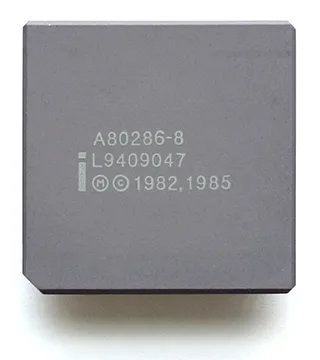
The Intel 80286, released in 1982, was a significant leap forward in x86 processor technology. It’s often overshadowed by its successors (the 80386 and beyond), but it was a crucial stepping stone, introducing features that would define modern computing. Here’s a comprehensive look at the 80286, covering its architecture, features, impact, and limitations:
1. Key Features & Architecture
- 16-bit Processor: Like its predecessor, the 8086/8088, the 80286 is a 16-bit processor. This means it processes data in 16-bit chunks.
- Clock Speeds: Initially released at 6 MHz, later versions reached 10 MHz and even 12.5 MHz. Clock speed was a major selling point at the time.
- Transistor Count: Around 134,000 transistors. This was a significant increase over the 8086/8088.
- Real Mode: The 80286 was fully backward compatible with the 8086/8088. It could run all existing 8086/8088 software in “Real Mode.” This was essential for adoption. In Real Mode, it operates much like its predecessors, with a 1MB address space.
- Protected Mode: This is the defining feature of the 80286. Protected Mode offered:
- 24-bit Address Space: Allowed access to up to 16MB of RAM (a huge amount for the time!).
- Memory Protection: Prevented programs from accidentally (or maliciously) overwriting each other’s memory. This significantly improved system stability.
- Multitasking Support: The hardware provided the foundation for multitasking operating systems.
- Privilege Levels: Allowed the operating system to control access to system resources.
- Segmented Memory Model: Like the 8086/8088, the 80286 used a segmented memory model. Memory was divided into segments, and addresses were formed by combining a segment register and an offset. While powerful, this model could be complex to manage.
- Improved Instruction Set: Added new instructions for string manipulation, bit manipulation, and other operations.
- On-Chip Memory Management Unit (MMU): The MMU was crucial for implementing Protected Mode and memory protection.
- Co-Processor Support: Supported the 8087 math co-processor for faster floating-point calculations.
2. Why Protected Mode Was a Big Deal (and its Challenges)
Protected Mode was revolutionary, but it wasn’t a smooth transition.
- Stability: Before Protected Mode, a crashing program could easily bring down the entire system. Protected Mode isolated programs, making crashes less catastrophic.
- Larger Programs: The 16MB address space allowed for much larger and more complex programs.
- Multitasking: Operating systems could run multiple programs concurrently, improving efficiency.
However, switching into Protected Mode was a major pain point
- Real Mode Requirement: The 80286 required the system to boot into Real Mode first. Then, a specific sequence of operations had to be performed to enter Protected Mode.
- Return to Real Mode: The 80286 could not directly return to Real Mode from Protected Mode. A system reset was required. This made multitasking and operating system design incredibly difficult. This limitation was a major criticism and was addressed in the 80386.
- Complexity: Programming in Protected Mode was significantly more complex than in Real Mode.
3. Impact and Usage
- IBM PC/AT (1984): The 80286 was the heart of the IBM PC/AT, which became the dominant PC architecture for several years. This cemented the 80286’s place in history.
- Early Multitasking OSes: While hampered by the limitations of Protected Mode, operating systems like OS/2 (initially developed by IBM and Microsoft) and early versions of Unix attempted to leverage the 80286’s capabilities.
- CAD/CAM Workstations: The larger memory space and improved performance made the 80286 suitable for demanding applications like Computer-Aided Design and Manufacturing.
- Early Networking: The 80286’s capabilities helped drive the development of early networking technologies.
- Transition to 32-bit Computing: The 80286 laid the groundwork for the 80386, which fully embraced 32-bit computing and addressed the limitations of Protected Mode.
4. Limitations & Why it was Superseded
Despite its advancements, the 80286 had significant limitations:
- Protected Mode Return Issue: The inability to return to Real Mode without a reset was a crippling flaw.
- Segmented Memory: The segmented memory model was complex and inefficient.
- Performance: While faster than the 8086/8088, the 80286’s performance was limited by its 16-bit architecture and the overhead of Protected Mode.
- Competition: The Motorola 68000 series offered a more elegant and powerful architecture, posing a serious challenge to Intel.
These limitations led to the development of the Intel 80386 in 1985, which addressed these issues and ushered in the era of 32-bit computing.
5. Technical Specifications (Summary)
- Data Bus Width: 16 bits
- Address Bus Width: 24 bits (in Protected Mode)
- Clock Speed: 6 MHz, 8 MHz, 10 MHz, 12.5 MHz (Minimum 4 MHz, maximum 25 MHz)
- Transistor Count: 134,000
- Memory Address Space: 1MB (Real Mode), 16MB (Protected Mode)
- Instruction Set: Extended 8086/8088 instruction set with new instructions.
- Packaging: Typically available in 68-pin PGA (Pin Grid Array) packages.
Resources for Further Exploration
- Wikipedia: https://en.wikipedia.org/wiki/Intel_80286
- CPU-World: https://www.cpu-world.com/CPUs/80286/
- YouTube – rehsd’s 80286 Build: https://www.youtube.com/playlist?list=PL7sb-_3xk_CAMDL_dj9l-plqSrEzcqx1G
In conclusion, the Intel 80286 was a pivotal processor that introduced the concept of Protected Mode and laid the foundation for modern operating systems and multitasking. While its limitations ultimately led to its replacement, its impact on the evolution of computing is undeniable. It represents a crucial step in the journey from 8-bit to 32-bit and beyond.