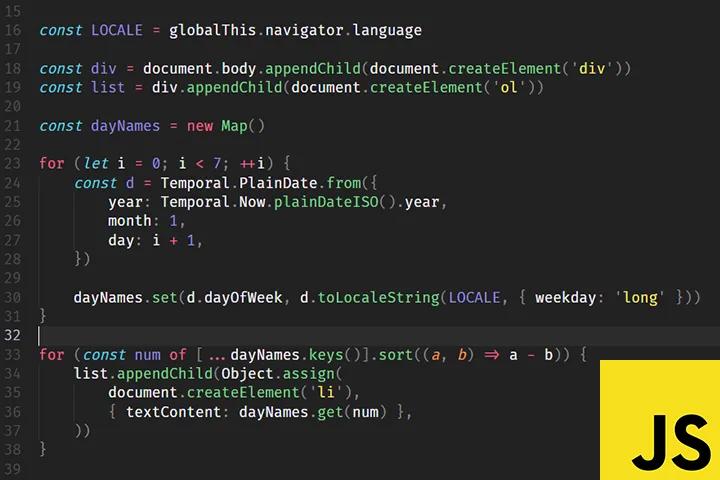
JavaScript is one of the most popular and versatile programming languages in the world. It’s essential for web development, but its reach extends far beyond that. Here’s a breakdown covering its history, core concepts, uses, strengths, weaknesses, and resources for learning:
1. History & Evolution
- Created in 1995 by Brendan Eich at Netscape: Initially named Mocha, then LiveScript, and finally JavaScript. It was designed to add interactivity to web pages.
- Not related to Java: Despite the name, JavaScript shares little in common with Java. The name was a marketing decision to capitalize on Java’s popularity at the time.
- ECMAScript Standardization: JavaScript’s standardization is managed by ECMA International. The standard is called ECMAScript (ES). Different versions of ECMAScript (ES5, ES6/ES2015, ES2016, etc.) introduce new features. ES6 (ES2015) was a major update, adding significant improvements.
- Continuous Evolution: JavaScript is constantly evolving with new features and improvements being added regularly.
2. Core Concepts
- High-Level: Abstracts away many low-level details, making it easier to write and read code.
- Interpreted: Code is executed line by line by a JavaScript engine (like V8 in Chrome, SpiderMonkey in Firefox, or JavaScriptCore in Safari). No compilation step is required (though transpilation is common – see below).
- Dynamically Typed: You don’t need to explicitly declare the data type of variables. The type is inferred at runtime. This offers flexibility but can also lead to runtime errors.
- Prototype-Based Object-Oriented: JavaScript uses prototypes for inheritance, which is different from the class-based inheritance found in languages like Java or C++.
- First-Class Functions: Functions can be treated like any other variable – passed as arguments, returned from other functions, and assigned to variables.
- Event-Driven: JavaScript is often used to respond to user interactions (clicks, key presses, etc.) and other events.
- Asynchronous Programming: JavaScript can handle multiple tasks concurrently without blocking the main thread, making it suitable for handling network requests and other time-consuming operations. This is often achieved using callbacks, Promises, and async/await.
3. Where is JavaScript Used?
- Front-End Web Development: The primary use case. JavaScript is used to create interactive and dynamic web pages. Frameworks like React, Angular, and Vue.js are popular for building complex user interfaces.
- Back-End Web Development: With Node.js, JavaScript can be used to build server-side applications, APIs, and microservices.
- Mobile App Development:
- Desktop App Development:
- Electron: Builds cross-platform desktop applications using web technologies. (e.g., VS Code, Slack, Discord)
- Game Development: JavaScript can be used for browser-based games and, with frameworks like Phaser, for more complex games.
- Machine Learning: Libraries like TensorFlow.js allow you to run machine learning models in the browser or Node.js.
- Internet of Things (IoT): JavaScript is used in some IoT devices and platforms.
4. Key Technologies & Tools
- HTML & CSS: JavaScript works with HTML (structure) and CSS (styling) to create web pages.
- JavaScript Engines: V8 (Chrome, Node.js), SpiderMonkey (Firefox), JavaScriptCore (Safari)
- Package Managers:
- npm (Node Package Manager): The default package manager for Node.js.
- Yarn: Another popular package manager.
- pnpm: A fast, disk space efficient package manager.
- Build Tools:
- Webpack: A module bundler that packages JavaScript, CSS, and other assets for deployment.
- Parcel: A zero-configuration web application bundler.
- Rollup: A module bundler focused on creating libraries.
- Transpilers:
- Babel: Converts modern JavaScript code (ES6+) into older versions that are compatible with older browsers. This is crucial for ensuring cross-browser compatibility.
- TypeScript: A superset of JavaScript that adds static typing. TypeScript code is transpiled into JavaScript.
- Frameworks & Libraries:
- React: A popular library for building user interfaces.
- Angular: A comprehensive framework for building complex web applications.
- Vue.js: A progressive framework for building user interfaces.
- Node.js: A runtime environment that allows you to run JavaScript on the server.
- Express.js: A popular Node.js web application framework.
- jQuery: A widely used (though now less essential) library for simplifying DOM manipulation and AJAX.
5. Strengths of JavaScript
- Ubiquity: Runs in virtually every web browser.
- Large Community: A huge and active community provides ample support, resources, and libraries.
- Versatility: Can be used for a wide range of applications.
- Fast Development: Dynamic typing and a large ecosystem of libraries can speed up development.
- Asynchronous Capabilities: Excellent for handling I/O operations without blocking the main thread.
- Cross-Platform: Can run on various operating systems and devices.
6. Weaknesses of JavaScript
- Security Concerns: Client-side JavaScript can be vulnerable to security exploits if not written carefully.
- Browser Compatibility: Different browsers may interpret JavaScript code slightly differently, requiring cross-browser testing. (Transpilers like Babel help mitigate this).
- Debugging: Debugging can be challenging, especially in complex applications.
- Dynamic Typing: Can lead to runtime errors that are not caught during development. (TypeScript addresses this).
- Performance: Can be slower than compiled languages like C++ or Java, especially for computationally intensive tasks.
7. Resources for Learning
- MDN Web Docs (Mozilla Developer Network): https://developer.mozilla.org/en-US/docs/Web/JavaScript – The definitive resource for JavaScript documentation.
- freeCodeCamp: https://www.freecodecamp.org/ – Interactive coding tutorials and projects.
- Codecademy: https://www.codecademy.com/learn/introduction-to-javascript – Interactive coding courses.
- Udemy & Coursera: Offer a wide range of JavaScript courses, both beginner and advanced.
- JavaScript.info: https://javascript.info/ – A detailed and modern JavaScript tutorial.
- Scrimba: https://scrimba.com/ – Interactive screencasts where you can edit the code directly in the video.
- Wes Bos: https://wesbos.com/ – Excellent JavaScript courses and tutorials.
In conclusion
JavaScript is a powerful and essential language for modern web development and beyond. Its versatility, large community, and continuous evolution make it a valuable skill for any aspiring programmer. While it has its drawbacks, the benefits often outweigh the challenges, especially with the help of modern tools and frameworks.
Is there anything specific about JavaScript you’d like to know more about? For example, are you interested in:
- A specific framework (React, Angular, Vue)?
- Node.js and server-side JavaScript?
- Asynchronous JavaScript (Promises, async/await)?
- TypeScript?
- A comparison to another language?