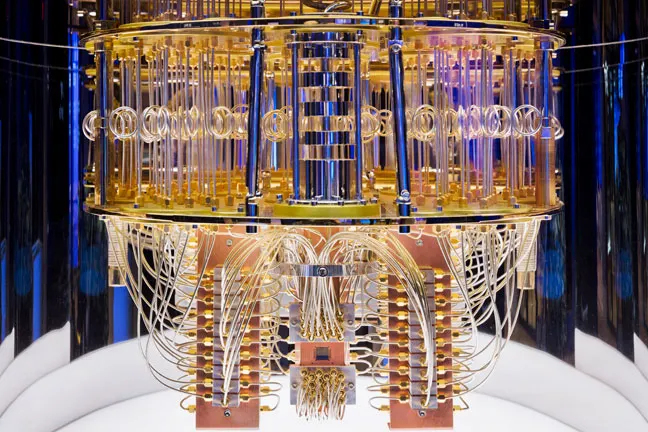
A quantum computer is a revolutionary type of computing device that uses the principles of quantum mechanics—the physics of subatomic particles—to process information in ways that traditional (“classical”) computers cannot.
To understand how they work, it helps to compare them to the computers we use every day.
1. The Core Difference: Bits vs. Qubits
- Classical Computers (Bits): Every piece of information in a standard computer (like your phone or laptop) is represented as a bit. A bit is like a light switch; it is either 0 (off) or 1 (on). Everything you do—from watching a video to sending an email—is a massive series of these 0s and 1s.
- Quantum Computers (Qubits): Quantum computers use qubits (quantum bits). Thanks to quantum mechanics, a qubit can exist in a state of superposition, meaning it can represent a 0, a 1, or both at the same time.
2. The Two “Magic” Principles
Quantum computers rely on two main quantum phenomena:
- Superposition: Imagine flipping a coin. A classical bit is the coin landing on either Heads or Tails. A qubit is the coin spinning on the table—it is technically both Heads and Tails simultaneously until you stop it to look. This allows a quantum computer to explore millions of possibilities at once.
- Entanglement: This is a physical phenomenon where two qubits become linked so that the state of one instantly influences the state of the other, no matter how far apart they are. This allows qubits to work together in a highly synchronized, complex network, creating exponential processing power.
3. Why are they so powerful?
Because of superposition and entanglement, the power of a quantum computer grows exponentially with each added qubit.
- If you add one bit to a classical computer, you get a little more memory.
- If you add one qubit to a quantum computer, you double its processing power.
A quantum computer with just a few hundred stable qubits could theoretically perform calculations that would take the world’s most powerful supercomputer thousands of years to finish.
4. What will we use them for?
Quantum computers won’t replace your laptop; they aren’t better at browsing the web or typing documents. They are designed for specific, highly complex mathematical problems:
- Drug Discovery & Chemistry: Simulating molecular structures to create new medicines or materials that are currently impossible to model.
- Cryptography: They could theoretically break most of today’s encryption (which relies on math problems classical computers find too hard to solve), which is why scientists are currently working on “post-quantum cryptography.”
- Optimization: Solving massive logistics problems, such as finding the most efficient global shipping routes or managing complex financial portfolios.
- Artificial Intelligence: Accelerating machine learning by processing massive datasets much faster than current hardware.
5. The Biggest Challenges
If they are so powerful, why don’t we have one on our desks?
- Fragility (Decoherence): Qubits are extremely sensitive. Vibration, temperature changes, or even a stray electromagnetic wave can cause them to lose their quantum state (this is called “decoherence”).
- Extreme Environments: Most current quantum computers must be kept at temperatures near absolute zero—colder than outer space—to function correctly.
- Error Rates: Because they are so sensitive, quantum computers currently make many errors. A major focus of current research is “Error Correction,” which ensures the computer can complete a calculation without losing the data.
Summary
We are currently in the “NISQ” era (Noisy Intermediate-Scale Quantum). This means we have working quantum computers, but they are small, prone to errors, and still experimental. They are essentially where the first vacuum-tube computers were in the 1940s—huge, difficult to maintain, and primitive, but holding the promise of changing the world forever.